A storyline of the Rule of Saint Benedict for laypeople, guided by See–Judge–Act
At Easter 1912, a twenty-nine-year-old curate in a working-class parish outside Brussels was handed the job nobody wanted: the women’s projects. He started by asking young seamstresses what their working day was actually like, and then he kept coming back to listen. Within a year, more than a thousand women had joined. Half a century later, a pope wrote the curate’s three steps into an encyclical: look, judge, act.
This week’s post tells the story of five laypeople, six Thursday nights, and the Rule of Saint Benedict read through Joseph Cardijn’s See–Judge–Act. The five are a night-shift nurse, a maintenance supervisor who grumbles before he speaks, a widow who knows every name in the parish, a newcomer nobody has ever asked about anything, and a pastoral associate who is sure she isn’t qualified to lead them. Then a young mother knocks on a locked door, and the reading group becomes something none of them planned.
The piece grew out of a lecture Dr. Paul M. Pearson gave on Thomas Merton and the Rule of Saint Benedict on 18 October 2026 at the Chicago gathering of the International Thomas Merton Society (ITMS) at St. Procopius Abbey in Lisle, IL. Pearson is Director and Archivist of the Thomas Merton Center at Bellarmine University in Louisville, Kentucky, and Chief of Research for the Merton Legacy Trust. He is Resident Secretary of the ITMS and served as its president from 2005 to 2007. Few people alive know Merton’s papers better.
My thanks to him for the spark.
Benedict called his Rule “this smallest Rule written down for beginners.” Every episode ends with questions for your own group.
Read the full storyline →
The Thursday Group
A storyline of the Rule of Saint Benedict for laypeople, guided by See–Judge–Act
The Curate Nobody Envied
At Easter 1912, a twenty-nine-year-old priest arrived at the parish of Our Lady in Laeken, on the northern edge of Brussels. He was a curate, at the lowest rung of the hierarchy. The parish gave him the least prestigious assignment: the“women’s projects.”
The young women of Laeken did not sit in classrooms. They sat at sewing tables in workshops and factories, and the parish knew them mostly through the sacraments they still attended. The curate started anyway. In August 1912, he opened a study circle with a local laywoman named Madeleine De Roo. A branch of the needleworkers’ union followed for the young seamstresses, then a second circle that the women themselves called the “petit syndicat,” the little union. Within a year he had drawn more than a thousand women into the parish’s groups.
The leaders paid a price. Some left good jobs to take places beside the women in factories that made rabbit-fur goods, rubber, and artificial silk. They ate their meals on the shop floor. They learned what the working day actually cost before anyone presumed to say what it meant.
Thirteen years later, defending the movement that grew out of those circles, the curate complained that in the industrial districts most people now knew the parish only as the place for baptisms, first communions, weddings, and funerals. He said the bonds among parishioners no longer mattered to people. Laeken had been his answer. He insisted the Young Christian Workers began there, in a parish women’s group, not in 1925, when the movement formally began.
His name was Joseph Cardijn. In May 1961, Pope John XXIII wrote his three steps into an encyclical: look, judge, act.
The Thursday Group is fiction.
The mechanism is not. A parish comes back to life the way Laeken did: someone asks people what their week actually looks like, and then listens to the whole answer.
How to Use This Storyline in your parish
This storyline follows five laypeople at a fictional Midwestern parish who meet on six Thursday evenings to read the Rule of Saint Benedict, and then decide to keep meeting. The story runs over several months, with planning and service between the reading nights. It is written for adult learners and parish discussion groups. Each episode reads aloud in about ten minutes and ends with “Pause and Discern” questions built on the See–Judge–Act method.
The method belongs to Joseph Cardijn (1882–1967), the Belgian priest who founded the Young Christian Workers (JOC) and taught young workers to look hard at their own lives in the light of the Gospel before deciding what to do. John XXIII gave the three steps official standing in Mater et Magistra §236: “First, one reviews the concrete situation; secondly, one forms a judgment on it in the light of these same principles; thirdly, one decides what in the circumstances can and should be done.“ He added that the three stages are usually expressed as “look, judge, act.“
Four voices, four jobs. Each source in the story does different work.
- The Rule of Saint Benedict supplies the practices: listening, counsel, humility, the rhythm of prayer and work, hospitality, and perseverance. Quotations follow the Saint Meinrad translation by Harry Hagan, OSB, and Hillary De Jean, OSB.
- See–Judge–Act supplies the process. The group does not merely discuss the Rule. They examine their actual lives (See), discern what the Rule and the Gospel ask in that light (Judge), and commit to something concrete (Act).
- The Second Vatican Council and the social encyclicals supply the test of whether a Benedictine way for laypeople is faithful. Lumen Gentium §31 teaches that laypeople seek the kingdom of God precisely by engaging temporal affairs and ordering them according to God’s plan, working like leaven from within to make the world holy. What a novel idea!
- Thomas Merton and Fr. Harry Hagan, OSB, speak as witnesses formed by the monastic tradition, not as extra authorities. Hagan names six hallmarks of Benedictine life: regula et traditio, stabilitas, conversatio, obedientia, ora et labora, and hospitalitas. The storyline leans on his reading throughout. Hagan is a monk at Saint Meinrad Archabbey, the hilltop community in southern Indiana where I did my college and graduate studies. Thank you, Harry!
The objection worth hearing first. The Rule is a sixth-century text written for men who had left the world. Its chapter on mutual obedience ends with brothers lying prostrate at a senior’s feet and, for the stubborn, corporal punishment or expulsion (RB 71). Carrying that book into a parish library on Thursday nights can look like dressing up in borrowed robes. The objection is serious, and Hagan’s first hallmark answers it without dismissing it. Regula et traditio means a written text read by a living community of interpreters. No book, he argues, can be lived by reading alone. Hagan also calls obedience a dangerous but necessary virtue, because it is so easily bent into a tool for manipulating people.
So the story avoids two mistakes. It does not turn lay life into a copy of monastic life. And it does not read Benedictine obedience as blind submission, or stability as staying put in a situation that harms you.
One historical note. Benedict of Nursia, Joseph Cardijn, Thomas Merton, and Harry Hagan lived in different times and never worked together. This storyline brings their ideas together on purpose. The convergence is the point of the exercise, not a historical claim. And that is coming from a historian.
For the group/Parish facilitator. Read each episode aloud, slowly. Leave a full minute of silence before the first question. Take the questions in order, and don’t skip to Act. Most groups want to fix things before they have finished looking, and this method slows that down.
Five People in a Parish Library
- Rosa Martínez, 38. A night-shift nurse raising two daughters on her own. Faithful, exhausted, and nearly invisible to the parish, because night nurses work Sundays.
- Walt Kowalczyk, 61. Maintenance supervisor at the high school, a few years from retirement. Baptized Catholic and suspicious of anything called a church committee. He grumbles before he speaks, and sometimes he doesn’t speak at all.
- Ada Johnson, 74. Widowed two years ago after a long marriage, and a parish volunteer for thirty years. She knows everyone’s name, including the people nobody else remembers.
- Tomás Rivera, 26. Moved to town for a remote IT job. Bright, polite, and so new that no one has ever asked his opinion about anything.
- Grace Umeh, 45. The parish pastoral associate, who convenes the group. She has read the Rule twice and is fairly sure she is not qualified to teach it. She is right, which turns out to help.
Episode One: The Ear of the Heart
The September parish council meeting was the worst anyone could remember. The agenda item was small: whether to replace the parish hall’s failing roof. The meeting was not about the roof. It was about twenty years of grievances, spoken and unspoken. It ended when a deacon gently suggested that the parish might need to learn to listen before making another decision.
Grace went home and pulled her old copy of the Rule off the shelf. Its first word is about listening: “Listen, O my son, to the instructions of the Teacher, and bring near the ear of your heart” (Prologue). She put a notice on the bulletin board. Six Thursday evenings in the parish library, reading the Rule of Saint Benedict. No agenda. No vote. Just listening.
Four people came. Grace made five.
On the first Thursday she did almost nothing. She read the Prologue aloud, slowly, and asked one question: “What did your actual week look like?”
Walt described fifty hours at the school and three trips with his wife to the cardiologist. Rosa had slept four hours. She listed her shifts, her daughters’ schedules, and the Sunday Masses she had missed for eleven years. Ada said her week was “the same as always.” It came out slowly: four hours of television a day and a phone that rarely rings. Tomás said, “Work, mostly,” and offered nothing else. Grace let the silence sit. Nobody pushed him.
Grace wrote their weeks on a whiteboard without comment. Then she read them what Fr. Harry Hagan says about Benedict’s word obedientia. It is built on hearing. In Hebrew, one verb, šamaʿ, means both “hear” and “obey.” “If you truly listen, then you will know how to respond,“ Hagan writes. “To obey is to respond to what one hears.“
Rosa stared at the whiteboard. “I have been a parishioner here for eleven years,” she said, “and this is the first time anyone has asked me that question.”
They had not read a single chapter yet. But they had already done the first thing the Rule asks, and the first step of the method the Church would later name. The Council asked the Church to keep “scrutinizing the signs of the times and of interpreting them in the light of the Gospel“ (Gaudium et Spes §4). On a Thursday night in a parish library, the signs of the times looked like a nurse’s shift schedule and a phone that did not ring.
Pause and Discern
- See. When did someone truly listen to you this week, and when did you truly listen to someone? Whose schedule in this room, or in your parish, is invisible to everyone else?
- Judge. Benedict begins with “the ear of your heart,” not with a rule about behavior. What does that order suggest about the disagreements in your parish or your household? What would change if listening came before deciding?
- Act. This week, ask one person a question you have never asked them. Listen to the whole answer without planning your reply.
- Teaching check. Gaudium et Spes §4 says the Church reads the signs of the times in the light of the Gospel. Test your group this way: is your agenda coming from people’s actual lives, or from conclusions you carried in the door?
- Carry home. Tomás said almost nothing tonight, and nobody made him. When is silence a person’s way of being heard?
Episode Two: Murmuring and the Youngest Voice
On the second Thursday, they read Chapter 3, “Calling the Brothers for Counsel.” Benedict tells the abbot to assemble the whole community on any important matter, “because often the Lord reveals to the younger what is better“ (RB 3). The chapter closes with a line from Sirach that Grace wrote on the whiteboard: “Do everything with counsel, and afterward you will not regret it.“
Walt snorted. “In my experience, the younger get talked over.” Then he made a better point. “And read the next line. The abbot hears everybody, then goes off and decides alone. That’s not counsel. That’s a suggestion box.”
Grace did not wave it away. He was right about the text. Counsel in the Rule is not a vote, and the decision still belongs to the abbot. “But look at what he can’t do,” she said. “He can’t decide before he has heard the youngest. The whole chapter is built to stop the person in charge from skipping that step.”
The evening proved Walt’s first point. When Grace asked what counsel the parish actually practiced, Walt delivered a twenty-minute monologue about the diocese, the roof, and the pastor of 1998. Ada interrupted him twice to correct his facts. Rosa, half-asleep, said nothing. Tomás took notes on his laptop and said nothing.
The room felt like the parish council again. This time Grace named it. She read Benedict’s warning about murmuratio, the grumbling that rots a community from the inside. Hagan lists it among three community sins, alongside anger and acedia, which he defines as “the temptation to abandon the commitment.“ Then she read Chapter 71, where Benedict asks the brothers to obey one another, not just the abbot. Hagan suspects this mutual obedience may be harder.
Then she did something Benedict’s abbot would recognize. She turned to the youngest person in the room. “Tomás. You’ve been taking notes all evening. What do you see?”
Tomás closed his laptop. “Honestly? This parish has no idea how it looks to someone who arrives cold. The website lists a Mass time that changed two years ago. There’s no sign on the door saying where anything is. The first time I came, I stood in the back for ten minutes, and three different people told me I was in their pew.” He paused. “I didn’t come back for a month. I only came back because Ada called me.”
Silence. Then Ada said quietly, “Fifty years I’ve been here. I never once thought about what it’s like to arrive cold.”
Hagan describes humility as “the ability to acknowledge and face the truth about oneself and the truth about others.” That is not self-erasure. It is honesty, and Ada had just practiced it in front of a room. Merton made the same point about holiness in Life and Holiness: becoming a saint means becoming more human, not less, with a larger capacity for concern and sympathy.
Their act that night was small and exact. They rewrote the meeting itself. Before any decision, they would hear every voice, starting with the youngest and quietest, and write every suggestion on the whiteboard without correction. Walt grumbled and agreed.
On the way out, he stopped at the door. “I’ve been talked over my whole life,” he told Tomás. “Guess I forgot what it looks like from the other side.”
Pause and Discern
- See. Who in your parish or family gets interrupted? Who gets asked, and who gets talked over? Listen to the murmuring in your community for a week. What is it actually about?
- Judge. Walt’s objection is fair: Benedict’s abbot still decides. Where is the line between counsel that shapes a decision and consultation that decorates one? Which kind does your parish practice?
- Act. Change one meeting you attend this week. Ask the person least likely to speak to speak first, and write down what they say before anyone responds.
- Teaching check. Lumen Gentium §35 teaches that the laity share Christ’s prophetic office and have been given a sense of the faith, so that the Gospel shines through daily social and family life. Test your new meeting this way: did the youngest voice actually change the decision, or did you hear it and file it away?
- Carry home. Ada had been the parish’s welcomer for fifty years and never noticed what Tomás noticed in ten minutes. What might you be too familiar with to see?
Episode Three: Reordering an Ordinary Week
On the third Thursday, they read Chapter 48, “The Daily Manual Labor.” It opens with the line everyone half-remembers: “Idleness is the enemy of the soul.“ The chapter’s real subject is rhythm. Benedict sets fixed times for work and fixed times for lectio divina, shifts the schedule with the seasons, and insists that “all things be done with measure on account of the weak“ (RB 48). For the sick and fragile, he asks for work that leaves them neither idle nor crushed.
Grace put their schedules back on the whiteboard, as she had the first night. Rosa’s week had no rhythm at all, only a loop: shift, daughters, sleep, shift. Walt’s had hardened into forty years of the same job, done well and noticed by no one. Ada’s days, since her husband died, had become what she bravely called “a lot of sitting.”
Hagan insists that ora et labora is not two things but one. He writes that the motto “stresses the unity of life,” and that God “continues to work where we work.” Then Grace read from John Paul II. In Laborem Exercens §25, he teaches that through work the human person shares in the Creator’s own activity, and, quoting the Council, that this awareness should reach even the most ordinary everyday activities. The Council itself put it more bluntly: “Let there be no false opposition between professional and social activities on the one part, and religious life on the other“ (Gaudium et Spes §43).
The Judge step that night was less a debate than a recognition. Rosa said, “I thought holiness was the one thing I didn’t have time for. You’re telling me the shifts themselves could be holy?” Walt, who had fixed things his whole life, looked at the whiteboard. “I guess I’ve been praying all along,” he said. “I just never called it that.”
“That’s close,” Grace said, “but Benedict is more careful than that. Work can share in God’s work. It doesn’t replace prayer, or Sunday. The Rule gives each its own hour.” Hagan says the same: both need their own time and place. The point is not work instead of prayer. The point is one life with room for both.
Their act: each of them drafted one page, a personal rule of life, deliberately unmonastic. Rosa negotiated Sunday nights off and moved her daughters’ bedtime prayers back to where they had been before the night shifts. Walt committed to ten minutes of morning prayer before the school furnace kicked on. Ada decided her labora would be the thing she already did best: one deliberate phone call every morning to a parishioner who lives alone. Tomás agreed to stop answering work messages on Sundays, which was harder for him than it sounds. Grace typed the pages and gave everyone a copy. That is more or less what a regula is: a written text carried by a living community.
Pause and Discern
- See. Draw your actual week: hours, not intentions. Where is the rhythm? Where is the treadmill? Where is the hour nobody, including you, has claimed?
- Judge. Benedict gives work and prayer each their own hour because they belong to one life. Where does your work already share in God’s work? Where has it stopped feeling like yours at all?
- Act. Write one page: your ordinary week, reordered. Keep it small enough to keep. Show it to one person in the group.
- Teaching check. RB 48 measures work, and Laborem Exercens grounds work in the dignity of the worker, not in output. Test your one-page rule this way: does it honor the tired and the weak, including you, or does it squeeze more devotion out of an already exhausted schedule?
- Carry home. Walt has fixed things for forty years, and almost nobody has thanked him. Whose work holds your parish together without anyone seeing it?
Episode Four: All Guests as Christ
On the fourth Thursday, the reading never happened. A young woman named Kaya knocked on the library door with a toddler on her hip and asked whether the food pantry was open. It was not. The pantry had cut its hours over the summer. She had walked there.
Grace made some calls while Ada found crackers and a juice box. The story came out in pieces. Kaya’s family had lost their apartment and was doubled up in a relative’s house, and the relative’s welcome was wearing thin.
The assigned reading sat untouched in the middle of the table. It happened to be Chapter 53: “Let all the guests at their arrival be received as Christ, for he himself will one day say: ‘I was a guest, and you received me.’“ Benedict adds that “great care and concern“ must be shown to the poor and to travelers, “for in them is Christ more especially received“ (RB 53).
Hagan does not make this chapter easier. He notes that Benedict identifies three groups with Christ: the abbot, the sick, and the guests. Hagan’s explanation is dry and honest. All three are trouble. They make demands, arrive at odd hours, and need care. “Hospitalitas means taking care of others,“ he writes, and it “is the opposite of defensiveness.“ Then he draws a line back to Chapter 3. Guests bring what the community cannot produce on its own: an outside view, a different experience, and critique. They are the youngest voice, arriving from the street.
Pope Francis points straight at this chapter in Fratelli Tutti §90. Benedict knew hospitality might disturb the discipline and silence of a monastery, Francis writes, and insisted anyway that “the poor and pilgrims be treated with the utmost care and attention.“ Hospitality, in Francis’s reading, is one way of meeting the challenge and the gift of encountering people outside one’s own circle.
Ada took it personally, which was exactly right. “I have been the official welcomer of this parish for fifty years,” she said. “I greet people at the door. I send cards. And I never once noticed that the pantry hours were cut, because I have never once needed them.”
The group saw it plainly: a family walking to a closed pantry, in a parish whose front door is locked outside office hours. They judged it the way Benedict would. Christ in this chapter is the guest, the poor one, the interruption. Merton, the monk most people picture in retreat from the world, had said as much: “The Christian cannot separate his life from the real world of work and struggle in which he lives“ (Life and Holiness).
The act began with a phone call about the pantry key. It ended at nine o’clock that night, with the group standing in the parking lot, agreeing to something larger than any of them had planned. That is where Episode Five begins.
Pause and Discern
- See. Who knocks on your parish’s locked doors? What disturbance has your community quietly organized itself to avoid? Who would know the answer better than you?
- Judge. Benedict receives the guest as Christ: the one who interrupts. What is the difference between being friendly and being hospitable? Which one costs something?
- Act. Name one person your community has welcomed with words but not with feet. Meet one concrete need this week, at an inconvenient hour if that is when the need arrives.
- Teaching check. Fratelli Tutti §90 calls hospitality a readiness to move beyond our own circle. Test your welcome this way: would Kaya, or whoever knocks on your door, describe the encounter as care, or as being managed?
- Carry home. Hagan says guests bring the critique a community cannot give itself. What has the last newcomer in your life tried to tell you?
Episode Five: Leaven
By the fifth Thursday, the reading group had become something none of them had planned: a group that proposes things.
The pantry question turned out to be structural. The hours had been cut because the two volunteers who ran it were exhausted. They were exhausted because the pantry was answering a need the county’s system had stopped answering. So the reading schedule paused, and the listening went on. For three weeks they made calls: to the county office, to the high school social worker (Walt knew her), to the social worker in Rosa’s emergency room. Most important, they listened to Kaya. She came to the library with the toddler asleep in a car seat and plainly told them what helped and what didn’t.
They saw a pattern, not an incident. Families were cycling between doubled-up housing, a closed pantry, and the emergency room. And the pantry’s hours fit its volunteers, not the families who needed it.
Then they judged, in the full light of what they had been reading. The Council teaches that laypeople are called to make the Church present and active in the places where only they can make it the salt of the earth (Lumen Gentium §33). Their field is not only helping the pastor with parish tasks. It is the secular order itself, the world of shift work and rent and hunger, which the Council asks the laity to penetrate and perfect with the spirit of the Gospel (Apostolicam Actuositatem§2). The same decree, describing lay formation, says laypeople must learn “to view, judge and do all things in the light of faith“ (Apostolicam Actuositatem §29). It is See–Judge–Act in the Council’s own words, and Cardijn was in Rome as a council father when those words were finished.
Merton gave them the sharpest judgment of all. People assume he guides them to retreat from the world. Yet he insisted that the contemplative life is not “incompatible with action, with creative work, with dedicated love“ (Contemplation in a World of Action). Rosa said what they were all thinking. “A prayer life that can’t look at a pantry schedule isn’t much of a prayer life.”
They took their proposal to the parish council, the same council that had fought about the roof. Rosa, who had never attended a council meeting, took a personal day to go. Tomás built a shared pantry schedule in an afternoon. Walt recruited three retired maintenance men as drivers. Ada became what she had always been, on purpose now: the one who knows every name. Kaya read the plan before anyone else and moved two hours.
One council member raised the strongest objection, and she meant it in good faith. “If the parish keeps patching what the county dropped, the county never has to fix it. Our charity becomes their excuse.” Nobody in the Thursday Group had an easy answer. They settled on doing both. The pantry would open at the new hours now, and the group would bring the pattern they had documented to the county office within the month, with Kaya’s permission and in her words.
The proposal passed. The council had not suddenly become holy. Five laypeople had learned to see clearly, judge honestly, and walk in with a plan that had names and dates attached.
Pause and Discern
- See. Name one structure in your community, not one person, that quietly fails the vulnerable. Who has the facts? Who has the experience? Are they ever in the same room?
- Judge. The council member’s objection is a real one: charity can let a broken system off the hook. When does serving people now delay justice for them later? How would your group do both?
- Act. Bring one proposal, with names and dates attached, to whatever council you belong to. Expect to be the youngest voice in the room, in Benedict’s sense.
- Teaching check. Apostolicam Actuositatem §2 speaks of perfecting the temporal order with the spirit of the Gospel. Test your proposal this way: are the people it affects agents in the plan, as Kaya was, or only its recipients?
- Carry home. Rosa took a personal day she could not really afford. What would it cost you to show up where the decision is actually made?
Episode Six: A Better Grade of Thistle
When the sixth reading night finally came, it was supposed to be a celebration. It was not.
The pantry ministry survived its first month and then wobbled. A driver quit. A delivery fell through. A council member complained about “the way it was proposed.” Rosa missed two meetings because her mother was in the hospital. Walt said something gruff to Tomás in the parking lot and stayed away from the library for a week. Ada admitted that some mornings she picked up the phone to call a parishioner who lives alone and could not make herself dial. Grief does not keep office hours.
Grace had saved the last chapters of the Rule for exactly this night. Chapter 72 asks the community to “bear most patiently with one another’s weaknesses, whether of body or of character“ (RB 72). Chapter 73, the last words of the whole Rule, practically shrugs. Whoever you are, Benedict says, as you rush toward the heavenly homeland, carry out “with the help of Christ this smallest Rule written down for beginners“ (RB 73). He ends his masterpiece by telling his monks they are just starting.
They read the ending aloud and laughed, the tired laugh of people who recognize themselves. Then Grace told them a story from Hagan’s talk. At a novitiate retreat, a monk named Br. James encouraged the new novices this way: “We don’t expect you to turn thorns into roses in just one year. We’re just looking for a little better grade of thistle.“
That is what Hagan means by conversatio. It is not arrival. It is movement: turning, becoming, giving oneself more and more to the life. Humility is its foundation, because real change begins with facing the truth about yourself. Hagan adds the half people forget. Changing yourself also means letting others change, and not needing them to stay who they were.
Rosa understood first. “I don’t have to be fixed by Sunday,” she said. Walt apologized to Tomás, briefly and without ceremony, which for Walt was a speech. Tomás accepted it the same way. Ada said she had made the call that morning after all. Kaya had come with the toddler. She said the new pantry hours were working for the families she knew. Then she added something nobody expected. The driver who quit had been kind, she said, and they had handed him a badly designed job.
Merton would have recognized the room. The spiritual life, he wrote, is not “a hothouse growth of artificial ascetic practices“ beyond the reach of ordinary people. “It is in the ordinary duties and labors of life that the Christian can and should develop his spiritual union with God“ (Life and Holiness). The Council said the same at higher volume. All the faithful, of whatever rank or status, are called to the fullness of Christian life and the perfection of charity (Lumen Gentium §40). On an ordinary Thursday, that fullness looked like a slightly better-grade thistle.
The six sessions were technically over. Nobody moved to leave. Finally Tomás, the youngest, said it. “Same time next week?”
They stayed. Hagan has a word for that too. Stabilitas is not a mood or a technique. It is commitment to a particular community: this place, these people, their tradition and their table. It is not staying where you are harmed. It is staying where you are needed, with people who are learning to bear you.
That was the act. That is wisdom speaking
Pause and Discern
- See. Where did your last good intention fail, not because it was wrong but because it was human-sized? Who noticed, and what did they do?
- Judge. Benedict calls his whole Rule a rule “for beginners.” What does that imply about how failure, repair, and starting over work in a community? What is the difference between stability and simply staying stuck?
- Act. Return to one commitment you dropped. Do not renew it heroically. Renew it humbly, and tell one person you are doing so.
- Teaching check. Lumen Gentium §40 teaches that holiness promotes “a more human manner of living“ in earthly society. Test your community this way: when someone wobbles, does the group bear patiently with their weaknesses of body or character, or does it quietly use them up?
- Carry home. Kaya defended the driver who quit. Who in your community has failed in a job that was badly built in the first place?
A Rule Small Enough for a Thursday
If your group remembers nothing else, keep this on an index card.
- Ask about the actual week. Hours, not intentions. Listening comes before counsel, and counsel comes before decision.
- Hear the youngest voice first. Youngest by age, or by tenure, or by distance from the center. Write it down before anyone answers it.
- Give work and prayer each an hour. One life, two rhythms. Measure both by the weak, including yourself.
- Treat the interruption as the guest. The knock at the locked door is the agenda.
- Bring a plan with names and dates. Make the people affected its authors, not its recipients.
- Expect a better grade of thistle. Bear with weakness. Start over. Come back next week.
In November 1965, the Council passed its Decree on the Apostolate of the Laity. Cardijn, made a cardinal that February, sat among the council fathers for that final session. Afterward Paul VI said that the seed a young Belgian priest had sown half a century earlier had borne fruit a hundredfold.
The seed was a study circle of seamstresses in a parish women’s group at Laeken. Nobody in Rome had planned it. A curate with the least promising assignment in the house had asked the young women what their working day was like, and then he kept coming back to listen.
That is all the Thursday Group did. It is all any parish has to do to begin.
Same time next week.
Source Map
- Episode One, listening. Rule: Prologue (the ear of the heart). Church: Gaudium et Spes §4. Hagan on obedientia as hearing and responding.
- Episode Two, counsel. Rule: RB 3 (the younger reveal what is better), RB 71 (mutual obedience). Church: Lumen Gentium §35. Hagan on humility, murmuratio, and acedia; Merton, Life and Holiness, on holiness as becoming more human.
- Episode Three, work and prayer. Rule: RB 48 (manual labor, rhythm, measure for the weak). Church: Gaudium et Spes §43; Laborem Exercens §25. Hagan on ora et labora as the unity of life.
- Episode Four, hospitality. Rule: RB 53 (all guests as Christ), with RB 3. Church: Fratelli Tutti §90. Hagan on hospitalitas as the opposite of defensiveness; Merton, Life and Holiness.
- Episode Five, lay action. Rule: RB 3 (counsel). Church: Lumen Gentium §§31, 33; Apostolicam Actuositatem §§2, 29; Mater et Magistra §236. Merton, Contemplation in a World of Action.
- Episode Six, perseverance. Rule: RB 72 (bear with weaknesses), RB 73 (a rule for beginners). Church: Lumen Gentium §40. Hagan on conversatio, stabilitas, and the better grade of thistle; Merton, Life and Holiness.
Sources (I put the links into the post because it may be hard to find these)
- Benedict of Nursia, The Rule of Benedict: The Saint Meinrad Translation with an Introduction, translated by Harry Hagan, OSB, and Hillary De Jean, OSB (Saint Meinrad Archabbey, hosted by PALNI Press, 21 January 2023). Chapters cited: Prologue, 3, 48, 53, 71, 72, 73.
- Harry Hagan, OSB, “A Twenty-Minute Novitiate: Six Hallmarks of Benedictine Spirituality”, presented to the American Benedictine Academy, Saint Meinrad, Indiana, August 2000; posted by Gerald W. Schlabach with the author’s permission.
- Second Vatican Council: Lumen Gentium (21 November 1964); Apostolicam Actuositatem (18 November 1965); Gaudium et Spes (7 December 1965).
- Encyclicals: John XXIII, Mater et Magistra (15 May 1961); John Paul II, Laborem Exercens (14 September 1981); Francis, Fratelli Tutti (3 October 2020).
- Thomas Merton, Life and Holiness (Herder and Herder, 1963); Contemplation in a World of Action (Doubleday, 1971). The Thomas Merton Center at Bellarmine University holds his papers.
- Joseph Cardijn at Laeken: Australian Cardijn Institute, “Social action as a means of reviving parish life” (4 February 2023), with Cardijn’s 1925 talk “The YCW and the Parish”; Joseph Cardijn Digital Library, “De Roo, Madeleine”; International YCW, “Cardijn’s Life”, with Cardijn’s 1958 recollection of the Laeken years; “Introducing Joseph Cardijn”, on his role at Vatican II.
Quotation notes. Rule quotations follow the Saint Meinrad translation, including the Prologue’s “Teacher” in place of the older “Master.” Hagan’s words come from “A Twenty-Minute Novitiate.” The Merton line on contemplation follows the wording of Contemplation in a World of Action as anthologized; his point about holiness making us more human is paraphrased from Life and Holiness. Dialogue spoken by the fictional characters is set in roman type; only quotations from sources are italicized.
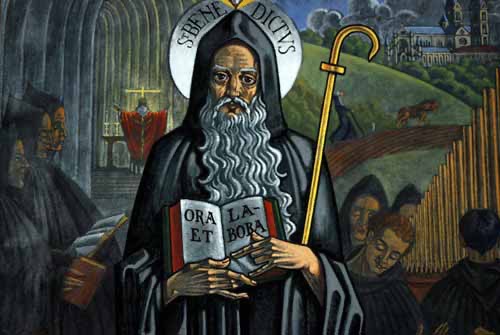
Image of St. Benedict on a mural in Memorial Lobby, Saint Meinrad Archabbey
Discover more from Innovate ~ Educate ~ Collaborate
Subscribe to get the latest posts sent to your email.
Leave a Reply