
Green Junction
This past week, efforts to address the world’s plastic pollution through an international agreement failed. Similar to the challenges in setting pathways to reduce global carbon emissions/climate change, the fossil fuel industry interfered with important steps needed to tackle the world’s massive plastic pollution problem. Instead, representatives from over 170 nations concluded INC-5 (the fifth session of the Intergovernmental Negotiating Committee) – a global treaty to address plastic pollution initiated in 2022 – with an agreement for a 2025 meeting.
Plastic production has increased at an incredible rate over the past 20 years, even as we learn more about the threats of these materials. Obnoxious amounts of plastic bags and packaging are used for nearly every purchase from most businesses. We know this type of plastic cannot be recycled, just downcycled, but most end up in landfills or the environment where it accumulates. People continue to buy enormous amounts of cheap plastic stuff that can only be thrown away. Plastic waste will stay on this earth for many human generations. There is no cost to the manufacturers for creating products that are not earth-compatible (products that only pollute the world); there is no cost to the consumer other than the low fees for garbage disposal. Furthermore, the plastic industry is a major contributor to climate change.
Plastic particles (microplastics, nanoplastics) have invaded all aspects of life on Earth. They are changing our microbiomes, invading our cells, and devastating species. The invasion includes thousands of chemical additives used to create desired products. The reasons for reducing the production of plastics and eliminating some of the most harmful additives are only growing. Yet, too many world leaders who are connected to the fossil fuel industries are impeding the necessary global agreements to reduce plastic production.
My interest in studying these pollutants is tied to my concern about water quality and my admiration for the Great Lakes. The amount of plastic waste in the Great Lakes, similar to other bodies of water around the world, is rising and will continue on this unhealthy trajectory unless the production of plastic is suppressed. If we think that the shores of these amazing bodies of fresh water will not appear like the ocean shores around the world that are egregiously littered with plastic waste, we are fooling ourselves.
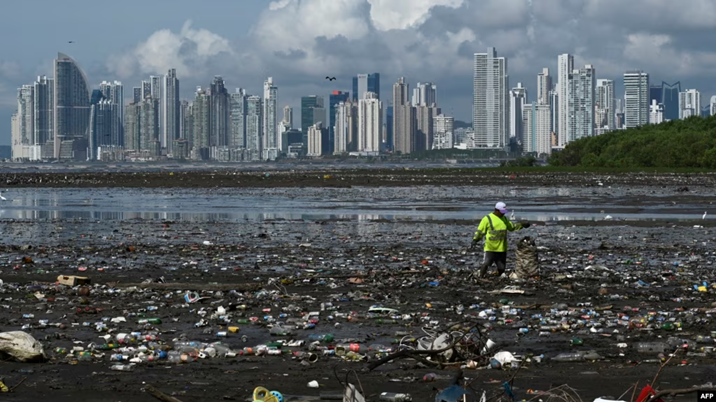
This is the reality in Panama (and many other coastal areas) – beaches inundated with plastic waste. Here was the appeal from Juan Carlos Monterrey, Special Representative for Climate Change & National Climate Change Director of the Ministry of Environment of Panama at INC-5. “We are not just negotiating a treaty. We’re deciding whether we care enough to save ourselves. Plastics for Panama are a weapon of mass destruction. Plastics are not convenient. Plastics are poison. Every piece that we allow to produce without limits is a direct assault on our health, on our nature, and our children. If we don’t get an ambitious treaty out of Busan (where plastics treaty negotiations took place), it will be a global betrayal. If we don’t get an ambitious treaty out of Busan, history will not forgive us.”
As we wait with hope for a global treaty, we can take part in personal and local solutions to plastic waste.
“A man collects garbage, including plastic waste, at the beach of Costa del Este, in Panama City. (File)”
Julie Peller, Ph.D., is an environmental chemist (Professor of Chemistry at Valparaiso University). She has been writing a weekly column called The Green Junction for the past seven years and is helping to move the call of Laudato Si to action forward. Her Research Interests are advanced oxidation for aqueous solutions, water quality analyses, emerging contaminants, air quality analyses, Lake Michigan shoreline challenges (Cladophora, water, and sediment contaminants), and student and citizen participation in environmental work.
Discover more from Innovate ~ Educate ~ Collaborate
Subscribe to get the latest posts sent to your email.
 Innovate ~ Educate ~ Collaborate
You must be logged in to post a comment.